Study with RK - Best blog for gk,gk in Hindi and Hindi gk tricks.

Showing posts with label biology gk. Show all posts

Wednesday, 1 February 2017

Biology notes on plants morphology for ssc

In this article we will discuss about the morphology of plants i.e. the structure and various parts of plants. This topic is important as per exam perspective.  Question from this topics are frequently asked in SSC CGL EXAM.

Morphology:

Morphology is the branch of biology of that deals with the study and forms of various parts of plants. It includes the external structure of plant such as stem, root, leaves, etc.

Root:

Primary roots are developed from the radicle of embryo.These roots are further develops into tertiary roots.Roots are always developed in soil.Roots are of two types i.e. Tap root and Adventitious root.

Modification of Tap roots:


Modification of Adventitious Roots:


Stem:

Stem is that portion of plant which grows upwards.It is develop from plumule

Modification of Stem:

Morphology of Leaves:

Its main function is to make food through photosynthesis.

Leaf are made up of leaf base, petiole and lamina.

At the base of leaf small leaf like structure called stipules are present.


Morphology of Flower:

Flower is the reproductive part of the plant.Flower are generally modified shoot.

Various parts of flower are as follows:

Androecium:

It is the male sex organ develops pollen grain.Its unit is stamen.Anther and filament are part of stamen.

Gynoecium:

It is the female reproductive organ.Its unit is carpel.Ovary, Style and Stigma are three different part  of Carpel.

Pollination:

The process of reaching of pollen grains to stigma is called pollination.There are two type of pollination i.e. Self- pollination and Cross-pollination.

Fertilization:

The process of fusion of male nucleus with egg cell is called fertilization.Fertilized egg is called zygote.In angiosperms the fertilization is triple fusion whereas in other category of plants it is double fusion.

Parthenocarpy:

When fruit are developed without fertilization i.e. in ovary this is called parthenocarpy.These types of fruits are seedless, example- Banana, Papaya, Orange, Grapes, Pine-apple etc.

Fruit and seeds:

Fruit is the ripened ovary developed after fertilisation.Seeds are mature ovule developed after fertilisation.

Fruits are divided into three parts:

Simple fruits like Banana, Guava etc.Aggregate fruits like strawberry, custard apple etc.Composite fruits like jackfruit and mulberry

Some fruit and their edible parts:


Biology notes: on plant tissue for ssc

In this article we will discuss about the plant tissues and hormones. Question from this section are important for competitive exam. This  topic are also useful for the upcoming SSC CGL Exam.

Plant Tissue

 Tissue : The group of cells of similar origin, structure and functions is called tissue.

 Types of Plant Tissue :

(A) Meristematic tissue :

Meristematic tissues are those tissues in which the cells remain forever young and divide actively throughout the life of the plant.

Some features of  Meristematic tissues are as follows :

It is round, oval or multi-sided. Its wall is thin and cytoplasm is homogeneous.Cell contains dense cytoplasm and a single large nucleus.There is lack of inter-cellular spaces between the cells.Apical Meristems : These tissues are found in the root and stem apex and the initial growth (specially length) of the plants take place due to these tissue.Lateral Meristems : Due to the division in these tissue growth in the girth of roots and stems takes place. Hence, it increases the width of the root and stem.Intercalary Meristems : They are located at the base of internode. In fact, this is the remains of the Apical Meristems, which is divided by the incoming of permanent tissues in the centre. Plants increase its length by the activity of this. Its importance is for those plants whose apex parts are eaten by vegetarian animals. After being eaten the apex part the plants grow with the help of intercalary meristems only. Like – grass.

(B) Permanent tissue :

Meristematic tissues after cell division and differentiation produce permanent tissue.

Permanent tissues are of following types

Simple tissue:

If permanent tissue is made up of similar types of cells, it is called simple tissue.

Complex tissue :

If permanent tissue is made up of one or more types of cells, it is called Complex tissue.

Complex tissues are of two types

Xylem :

Xylem is a conducting tissues. Its main functions are –

Conduction of water and minerals and To provide mechanical consistency.

Phloem : This is a conducting tissue. Its main function is to conduct foods prepared by the leaves to different parts of the plant.

Plant Hormones:

Following  hormones are found in plants –

Auxins :

Auxins was discovered by Darwin in the year 1880.

This is the hormone which controls the growth of plants.

Its formation takes place in the apex parts of the plants.

Its main functions are –

(i) It prevents the separation of the leaves.

(ii)  It destroys the straws.

(iii) It saves the crops from falling.

Gibberellins :

It was discovered by a Japanese scientist Kurosava in the year 1926.

Its main function are as follows :

It turns the dwarf plants into long plants.It helps in creating flowering. It hep in breaking the dormancy of plant.It motivates the seeds to be sprout.It increases the activity of cambium in the wooden plants. Large sized fruits and flowers can be produced by its scattering.

Cytokinins :

It was discovered by z in the year 1955 but it was named by Lethem.

Its main function are as follows:

 It naturally works in coordination with auxins.It help in cell division and development in the presence of auxins.   It help in breaking the dormancy of seed.It is helpful in making RNA and protein.

Abscisic Acid or ABA :

This hormone was initially discovered by Carnes and Adicote and later on by Waring.

Its main function are as follows:

This hormone is against the growth. It keeps the seeds & bud in dormant condition.It plays main role in separation of leaves. It delays in flowering of long day plant.

Ethylene :

This is the only hormone which is found in gaseous form.

Its main functions are as follows:

It helps in the ripening the fruits. It increases the number of female flowers.It motivates the separation of leaves, flowers and fruits.

Florigens :

It is formed in leaves but helps in blooming of the flowers.It is also called flowering hormones

Traumatic :

This is a type of dicarboxylic acid.It is formed in injured cells by which the injury of plants is healed.

Biology notes : cell devision and biomolecules

In this article we will discuss about the Cell division and Biomolecules. Question form this topic frequently asked in SSC Exam.

Cell Division

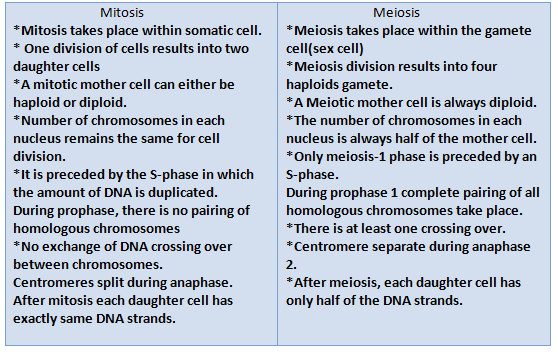
Cell division is the process by which the parent cell is divided into two or more cells. Cell division is a part of the cell cycle. Cell division is generally of two types:

(1) Mitosis

(2) Meiosis

The major difference between Mitosis and Meiosis


Biomolecules:

chemical compounds found in living organisms.They are the building block of the life and perform important functioning in living organisms.They are compounds of carbon, hydrogen, oxygen, nitrogen, sulphur and phosphorus.

Lipids:

Lipids include molecules such as neutral fats, oils, steroids and waxes. They perform the following function:

They are hydrophobic in nature.Absorbs shocks.Control the cell activities through hormone actions.Store the concentrated energy.Protection against the desiccation.Steroids is a type of lipids which function both as hormones and structural material.

Carbohydrates:

Carbohydrates are hydrates of carbon.Carbohydrates occur both as monomers and polymers.Small carbohydrates are called as sugars, which commonly include Monosaccharides (single sugar) and Disaccharides( bi sugar). Larger carbohydrates are called as polysaccharides.Store the short term energy.It acts as the structural building material.

Proteins

Proteins are polymers of amino acids; proteins typically make up about half of the total weight of the biomolecules in a cell excluding water. Proteins play a wide variety of role such as:

Enzymes: in the form of catalyst.Structural material: in the form of keratin (protein found in hair and nails).Contraction: as actin and myosin fibers that interact in muscle tissues for contraction and relaxation.Signalling : Hormones such as insulin that regulate sugar level in blood

Nucleic Acid

Nucleic acids are polymers of nucleotide.Each nucleotide has three main components:A ring shaped molecule which belongs to the class of nitrogenous base.A 5-carbon pentose sugar.One or more phosphate groups.DNA and RNA are two types of nucleic acid.

Biology notes: cell and it's types

Today we are providing notes on Cell and its types for GS portion of the SSC CGL. These notes cover almost all the points related to Cell.

 Cell and its Types

Cell: Cell is the structural and functional unit of all living organisms. The organisms which are made up of a single cell is called as the Unicellular  while the organisms made up of multiple cell like human being , cow and buffalo are called as the multi-cellular cell. Cell was discovered by the Robert Hooke, an English scientist in 1665.

All cells contain three basic structures:

Plasma membrane: It is made up of lipids and proteins and help in the transportation of nutrients form the external environment to inside the cell.Cytoplasm: It is a fluid like substance that contains Cytosol and cell organelles such as mitochondria, chloroplast etc.Nucleus : It is the main parts of the nucleus as it contains the genetic information as DNA present in it. Fluid inside the nucleus is Nucleoplasm.

*Protoplasm is the combined form of the Nucleoplasm and Cytoplasm.

*The Non-living things inside the cell are called as the Deutoplasm.

Cell Theory:

Cell theory is given by M Schleiden a German Botanist and T Schwann a British Zoologist. The main points of the cell theory are.

All living organisms are made up of the cells.

All cells arise from the pre-existing cell (Omnis cellula e cellula).

Virus does not follow the cell theory.

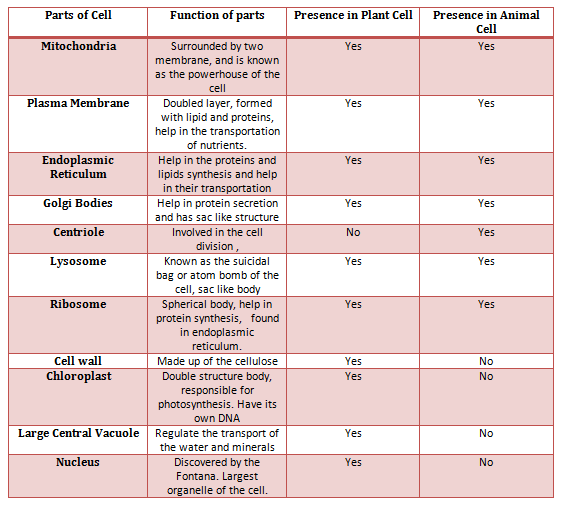
                                                                              Detailed of Animal and Plant Cell


Types of cells:

There are primarily two types of cells, i.e. prokaryotic and eukaryotic cells.

                                                   Difference between the two cells

Chromosome:

chromosomes are the condensed form of the DNA. The cause of this condensation is special types of protein known as histones. When DNA is not condensed, it is called as chromatids. During cell division chromosomes show chromatids held together at a point called Centromere. End points of the chromosomes are known as Telomere. On the basis of position, centromere can be metacentric (present at the centre), sub metacentric (little away from the centre), acrocentric (situated close to the end), and telocentric (terminal centromere).

Types of Chromosomes:

Lampbrush Chromosomes: It was first discovered by the Balbiani , and it resemble the shape of the lamp brush.

Polytene Chromosomes: It was discovered by Balbiani  in salivary gland of  Chionomus larvae.

Genes:

Chromosomes also contains various genes. Gene acts as a unit  of inheritance in living organisms. It controls the transfer of genetic information from one generation to the next generation.

                                                           Have a nice day guys


Monday, 5 September 2016

मानव शरीर से संबंधित संख्यात्मक तथ्य

मानव शरीर से संबंधित संख्यात्मक तथ्य

1. वस्यक व्यक्तियों में अस्थियों की संख्या : → 206

2. खोपड़ी में अस्थियां : → 28

3. कशेरुकाओ की संख्या: →33

4. पसलियों की संख्या: →24

5. गर्दन में कशेरुकाएं : →7

6. श्वसन गति : →16 बार प्रति मिनिट

7. हृदय गति : →72 बार प्रति मिनिट

8. दंत सूत्र : → 2:1:2:3

9. रक्तदाव : →120/80

10. शरीर का तापमान : → 37 डीग्री 98.4 फ़ारेनहाइट

11. लाल रक्त कणिकाओं की आयु : → 120 दिन

12. श्वेत रक्त कणिकाओ की आयु : →1 से 3 दिन

13. चेहरे की अस्थियां: → 14

14. जत्रुक की संख्या :→2

15. हथेली की अस्थियां: → 14

16 पंजे की अस्थियां: → 5

17. ह्दय की दो धड़कनों के बीच का समय : → 0.8 से.

18. एक श्वास में खीची गई वायु : →500 मि.मी.

19. सुनने की क्षमता : →20 से १२० डेसीबल

20. कुल दांत : →32

21. दूध के दांतों की संख्या : → 20

22. अक्ल दाढ निकलने की आयु : → 17 से 25 वर्ष

23. शरीर में अमीनों अम्ल की संख्या : → 22

24. शरीर में तत्वों की संखया : → 24

25. शरीर में रक्त की मात्रा : → 5 से 6 लीटर

(शरीर के भार का 7 प्रतिशत)

26. शरीर में पानी की मात्रा : → 70 प्रतिशत

27. रक्त का PH मान : → 7.4

28. ह्दय का भार : → 300 ग्राम

29. महिलाओं के ह्‌दय का भार → 250 ग्राम

30. रक्त संचारण में लगने वाला समय → 22 से.

31. छोटी आंत की लंबाई → 22 फीट

33. शरीर में पानी की मात्रा → 22 लीटर

34. मष्तिष्क का भार → 1380 ग्राम

35. महिलाओं के मष्तिष्क का भार → 1250 ग्राम

36. गुणसूत्रों की संख्या → 23 जोड़े

37. जीन्स की संख्या →97 अरब

छोटी आंत्र की लम्बाई

6.25 मीटर

यकृत का भार (पुरूष)

1.4-1.8 किग्रा.

यकृत का भार (महिला में)

1.2-1.4 किग्रा.

सबसे बड़ी ग्रंथि

यकृत

सर्वाधिक पुर्नरूदभवन कि क्षमता

यकृत में

सबसे कम पुर्नरूदभवन कि क्षमता

मस्तिष्क में

शरीर का सबसे कठोर भाग

दाँत का इनेमल

सबसे बड़ी लार ग्रंथि

पैरोटिड ग्रंथि

शरीर का सामान्य तापमान

98.4 फ(37 c)

शरीर में रूधिर की मात्रा

5.5 लीटर

हीमोग्लोबिन की औसत मात्रा (पुरूष)

13-16 g/dl

हीमोग्लोबिन की औसत मात्रा (महिला में)

11.5-14 g/dl

WBCs की कुल मात्रा

5000-10000/cu mm.

सबसे छोटी WBC

लिम्फ्रोसाइट

सबसे बड़ी WBC

मोनोसाइड़

RBCs का जीवन काल

120 दिन

WBC का जीवन काल

2-5 दिन

रूधिर का थक्का बनने का समय

3-6 मिनिट

सर्वग्राही रूधिर वर्ग

AB

सर्वदाता रूधिर वर्ग

O

सामान्य रूधिर दाव

120/80 Hg

सामान्य नब्ज गति जन्म के समय

140 बार- मिनिट

सामान्य नब्ज गति 1 वर्ष की उम्र में

120 बार- मिनिट

सामान्य नब्ज गति 10 वर्ष की उम्र मे

90 बार- मिनिट

सामान्य नब्ज गति वयस्क

70 बार- मिनिट

हृदय गति

72 बार- मिनिट

सबसे बड़ी शिरा

इंफिरीयर वेनाकेवा

सबसे बडी धमनी

एब्सोमिनल एरोटा

वृक्क का भार

150 ग्राम

मस्तिक का भार

1220-1400 ग्राम

मेरूदण्ड की लम्बाई

42-45 cm

क्रेनियल तंत्रिकाओं की संख्या

12 जोडे

स्पाइनल तंत्रिकाओं की संख्या

31 जोडे

सबसे लम्बी तंत्रिका

सिएटिक

सबसे पतली एवं छोटी तंत्रिका

ट्रोक्लियर

सबसे बडी तंत्रिका

ट्राइजिमिनल

सबसे बड़ी कोशिका

तंत्रिका कोशिका

सबसे बडी अंत: स्त्रावी ग्रंथि

थॉयराइड

आकस्मिक ग्रंथि

एड्रिनल

सबसे छोटी अंत: स्त्रावी ग्रंथि

पिट्यूटरी ग्रंथि

लड़कियों में यौवनावस्था का प्रारम्भ

13 वर्ष

महिलाओ में मासिक धर्म का काल

28 दिन

गर्भावस्था की अवधि

266-270 दिन

अस्थियों की कुल संख्या

206

सबसे छोटी अस्थि

स्टेपिज (म्ध्य कर्ण में )

सबसे लम्बी अस्थि

फीमर (जंघा में )

कसेरूकाओं की कुल संख्या

33

मांसपेशियों की कुल संख्या

639

सबसे लम्बी पेशी

सारटोरियस

बड़ी आंत्र की लम्बाई

1.5 मीटर
Email Me!

Saturday, 13 August 2016

Biology knowledge

Biology knowledge
*🔘तम्बाकू की पत्तियों में निकोटिन नामक पदार्थ पाया जाता है।*
*🔘अनुवांशिकी के पिता ग्रेगर जॅान मेंडल को कहा जाता है।*
*🔘हरगोविंद खुराना को नोबेल पुरस्कार जीन DNA से संबंधित खोज के लिए मिला था।*
*🔘माइटोकांड्रिया ( Mitochondria ) को कोशिका का पावर हाउस कहते हैं।*
*🔘राइबोसोम ( Ribosome ) को प्रोटीन की फैक्ट्री कहा जाता है।*
*🔘मानव शरीर में गुणसूत्रो की संख्या 46 ( 23 जोड़ा ) होती है।*
*🔘चेचक का टीका की खोज एडवर्ड जैनर ने की थी।*
*🔘स्वस्थ मनुष्य के शरीर के रक्त का पी. एच. मान 7.4 होता है।*
*🔘लाल रक्त कणिकांए RBC का निर्माण अस्थिमज्जा में होता है।*
*🔘हल्दी तथा आलू तना का* *भूमिगत रूपांतरण है।*
*🔘कोशिका की खोज अंग्रेज वैज्ञानिक राबर्ट हुक ने की थी।*
*🔘नवजात बच्चों के शरीर में 300 हड्डियां होती है।*
*🔘मानव शरीर की सबसे लंबी हड्डी को 'फीमर' कहते है ( जांघ की हड्डी )।*
*🔘मनुष्य के शरीर की सबसे छोटी हड्डी 'स्टेप्स' है जो कान में होती है।*
*🔘मनुष्य की छाती में दोनों तरफ 12 -12 पसलियां होती है।*
*🔘RBC लाल रक्त कण की कब्रगाह यकृत और प्लीहा को कहा जाता है।*
*🔘रक्त का थक्का बनाने में विटामिन के k सहायक होता है।*
*🔘रक्त समूह ( Blood Group ) एवं आर एच तत्व ( RH Factor ) की खोज कार्ल लैंडस्टीनर ने की थी।*
*🔘AB रक्त समूह में एण्टीबॅाडी नहीं पाई जाती है, इसलिए यह सर्वग्रहता कहलाता है।*
*🔘O रक्त समूह में एणटीजन नहीं होता है यह सर्वदाता कहलाता है।*
*🔘मनुष्य के हृदय का भार लगभग 300 ग्राम होता है।*
*🔘स्वस्थ मनुष्य का हृदय एक मिनट में 72 बार धड़कता है।*
*🔘स्वस्थ मनुष्य रक्त दाब 120/80 mmhg ( Systolic / diastolic ) होता है।*
*🔘यूरोक्रोम की उपस्थिति के कारण मूत्र का रंग हल्का पीला होता हैं।*
*🔘एलीसा प्रणाली ( ELISA Test ) से एड्स बीमारी के HIV वायरस का पता लगाया जाता है।*
*🔘टिटनेस से शरीर का तंत्रिका तंत्र प्रवाहित होता है।*
*🔘स्वस्थ मनुष्य के शरीर में रक्त का औसत 5 - 6 लीटर होता है।*
*🔘मनुष्य के रक्त का शुद्धिकरण किडनी में होता है।*
*🔘मानव शरीर की सबसे छोटी ग्रंथि पिट्यूटरी मस्तिष्क में होती है।*
*🔘मानव शरीर की सबसे बड़ी ग्रंथि यकृत होती है।*
*🔘इन्सुलिन की खोज बैटिंग एवं वेस्ट ने की थी।*
*🔘वस्तु का प्रतिबिंब आँखों के रेटिना में बनता है।*
*🔘नेत्रदान में आँख के कार्निया को दान किया जाता है।*
*🔘सोयाबीन में सर्वाधिक प्रोटीन ( 42% ) पाया जाता है।*
*🔘जल में घुलनशील विटामिन B एवं C है।*
*🔘विटामिन सी C खट्टे फलों में पाया जाता है।*
*🔘विटामिन सी की रासायनिक नाम 'स्कर्वीक एसिड' है।*
*🔘जीव विज्ञान के जनक अरस्तू को कहा जाता है।*
*🔘जीव विज्ञान शब्द का सर्वप्रथम प्रयोग लैमार्क एवं ट्रेविरेनस ने किया था।*
*🔘वनस्पति विज्ञान के जनक थियोफ्रस्ट्स को कहा जाता है।*
*🔘आधुनिक वर्गीकी ( Modern taxonomy ) के पिता लीनियस को कहा जाता है।*
*🔘एडवर्ड जेनर ने चेचक के टीका की खोज की थी।*
*🔘आम का वनस्पतिक नाम मेनजीफेरा इंडिका है।*
*🔘कार्बन डाई आक्साइड गैस ग्रीन हाउस प्रभाव में सबसे ज्यादा योगदान करती है।*
*🔘त्वचा का कैंसर सूर्य की पराबैंगनी किरणों से होता है।*-

Note - अगर आपके पास हिन्दी में अपना खुद का लिखा हुआ कोई Motivational लेख या सामान्य ज्ञान से संबंधित कोई साम्रगी या प्रतियोगी परीक्षाओं से संबंधित कोई भी साम्रगी है जो आप हमारी बेबसाइट पर पब्लिश कराना चाहते है तो क्रपया हमें rak.manth@gmail.com पर अपने फोटो व नाम के साथ मेल करें ! पसंद आने पर उसे आपके नाम के साथ पब्लिश किया जायेगा ! क्रपया कमेंट के माध्यम से बताऐं के ये पोस्ट आपको कैसी लगी आपके सुझावों का भी स्वागत रहेगा Thanks !

Popular Posts

Powered by Blogger.